
Why train workplace safety in virtual reality
· SST-XR team
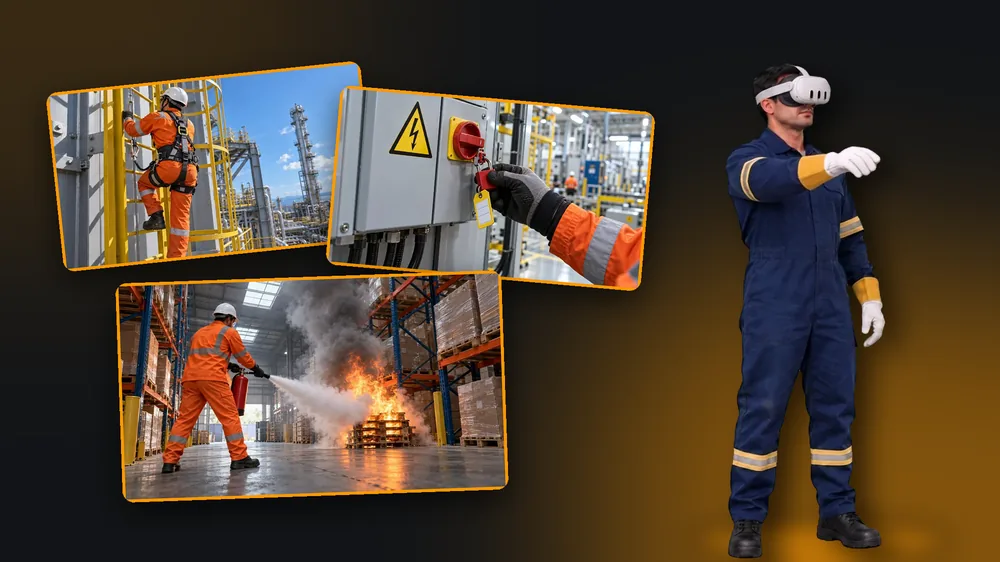
Anyone who organizes occupational safety training knows the dilemma: the part that teaches the most is the practice, and practice is exactly the most expensive, the hardest to schedule and, sometimes, the riskiest. Putting out a real fire, climbing a ladder several meters off the ground or working on an electrical panel are not things you repeat ten times per trainee in one morning.
Virtual reality helps the instructor solve a good part of this problem. It does not take the instructor's place or replace what the regulations require: it puts each person in front of the risk situation as many times as needed, without danger and without waste.
What changes when trainees train in virtual reality
1. Every trainee practices, not just watches
In a fire drill with real fire, few trainees actually get to use the extinguisher, and only for a few seconds. The others watch. In virtual reality, each person goes through the whole scene: they identify the burning material, choose the extinguisher, pull the seal, approach and aim at the base of the flames.
2. Mistakes happen in the right place
Choosing the wrong extinguisher or locking out the wrong disconnect switch has a visible consequence inside the training: the fire flares up again or spreads, the narration explains what went wrong and the trainee tries again. This kind of mistake, made in a safe environment, is what stays in memory when the situation happens for real.
3. Lower costs and less logistics
A refilled extinguisher, an area prepared for a controlled fire, scaffolding set up, a machine stopped for the class. All of this costs money and depends on scheduling. With the headsets, training happens in an ordinary room, at any site, and each trainee usually takes 5 to 15 minutes.
4. Managers see each person's results
An attendance sheet says who was in the room, but not who learned. In SST-XR, each session generates a score, steps completed, mistakes and attempts on the training management dashboard. You can see who is up to date, who needs to retake a training and which groups have not trained yet.
5. It works for people who have never used virtual reality
A common barrier is the belief that only people who play video games will do well. In SST-XR, trainees use only their hands as the controllers: they pick up the extinguisher, turn the valve and apply the padlock with their own hands. There are no buttons to memorize, and most people get the hang of it quickly.
Where virtual reality makes the biggest difference
- Fire response: choosing the right extinguisher for each class of fire and fighting it without real flames. See the Warehouse fire training.
- Work at height: inspecting the equipment, connecting the lanyard and climbing the ladder with three points of contact. See Ladder climbing.
- Energy lockout (LOTO): following the lockout and tagout sequence before maintenance, in Electrical lockout and Hydraulic and pneumatic lockout.
- Hazard recognition: seeing the danger before it happens, in Warehouse hazards and Factory traffic, where pedestrians and forklifts share the same aisle.
What virtual reality does not do
It is important to be clear: virtual reality training complements the company's training program and does not replace the content and hours required by the safety regulations that apply to your operation. It comes in where practice is expensive, dangerous or hard to repeat, and makes the rest of the program more efficient.
How to get started
- Choose the most important risks in your operation, for example fire, height or machine lockout.
- Register the groups on the dashboard and define which trainings each one must complete and how often.
- Pair the headsets, Meta Quest 3, 3S or Quest 2, with a code, just once.
- Follow up on the dashboard to see who has trained, the scores and who needs to retake a training.
SST-XR works without internet during training and sends the results when the headset finds a network, in Portuguese, English and Spanish. See the complete training catalog or request a demo to see everything working.