
Does immersive training work? What studies and companies say
· SST-XR team
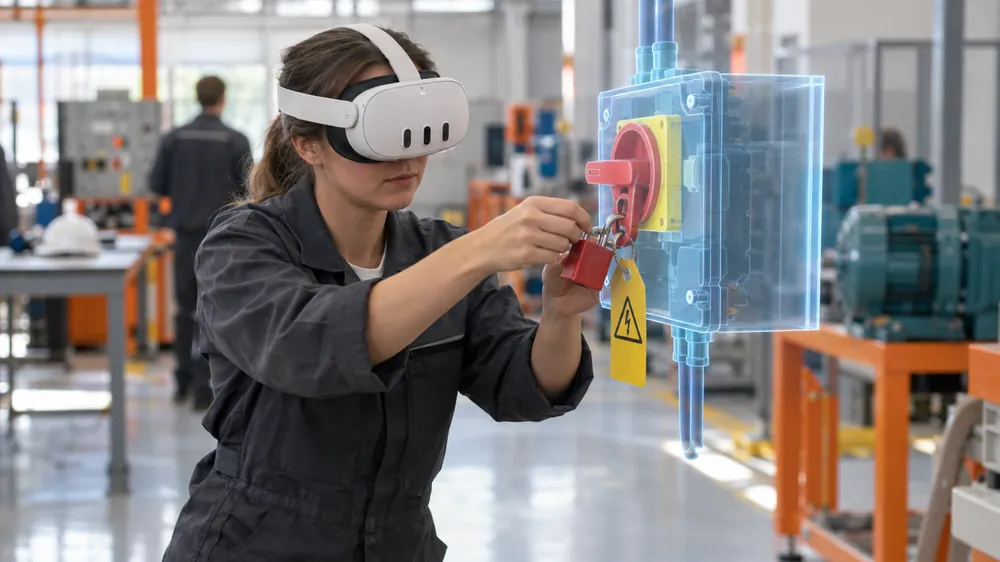
Every safety manager has wondered whether training really changes anything on the factory floor. The attendance sheet says who was in the room, but not who learned, or who will remember the procedure a month from now.
Immersive training, done with virtual reality headsets, has already been tested by researchers and companies in several countries as one more tool in the hands of those who teach. Below we have gathered only studies with clear results and sources open for consultation.
1. A meta-analysis of 52 studies: people learn more and remember longer
A group of researchers reviewed 52 articles published between 2013 and 2021 on safety training in virtual reality. The work was published in the scientific journal Safety Science in 2023.
The conclusion of the study's two meta-analyses is straightforward: when virtual reality is part of safety training, trainees gain more knowledge and retain what they learned better. In other words, they learn more at the time and forget less afterwards.
Source: Scorgie, Feng, Paes, Parisi, Yiu and Lovreglio, Virtual reality for safety training: A systematic literature review and meta-analysis, Safety Science, vol. 171.
2. Construction: better performance and knowledge retained four weeks later
In New Zealand, researchers at Massey University compared a virtual reality training on excavation safety with the health and safety manual normally used, in a controlled experiment.
Right after the training, the virtual reality group showed significantly higher practical performance, knowledge acquisition and confidence than the group that only read the manual. And the knowledge was still there four weeks later.
Source: Feng, Lovreglio, Yiu, Acosta, Sun and Li, Immersive virtual reality training for excavation safety and hazard identification, Smart and Sustainable Built Environment.
3. Building sites: more attention and an advantage that lasts
In one of the first studies of its kind, published in 2013 in the journal Construction Management and Economics, 66 people were trained in construction safety, some of them in an immersive 3D environment. Their knowledge was tested before, right after and one month after the training.
The researchers concluded that the immersive environment helped trainees keep their attention and focus and that the gain held up over time, with a significant result in two of the three areas tested, stone cladding and cast-in-place concrete.
Source: Sacks, Perlman and Barak, Construction safety training using immersive virtual reality, Construction Management and Economics, vol. 31.
4. Mining in Australia: 88% of rescue teams rated the training a success
Coal Services, which trains the rescue teams of the coal mines in New South Wales, Australia, evaluated virtual reality training at its four training stations together with the University of Wollongong. 284 rescuers were surveyed before and after the immersive sessions.
In the final report, 88% rated the virtual reality session as successful or very successful.
How rescuers rated the immersive training
284 coal mine rescuers, New South Wales, Australia
Source: Perez, Palmisano and Pedram, final project report for Coal Services (2016), and the article Lessons Learned From Immersive and Desktop VR Training of Mines Rescuers, Frontiers in Virtual Reality (2021).
5. Fuel stations: Trafigura and the three-month pilot
Trafigura, an international energy and commodities group, brought virtual reality into safety training at service stations, to prepare teams for risk situations that cannot be safely reproduced day to day. After a three-month pilot, participants reported:
- 100% felt safer, more confident and better prepared;
- 91% improved important behaviors at work;
- 82% gained new skills for their role.
What participants reported after the pilot
Trafigura, three-month pilot at service stations (percentage of participants)
Source: Trafigura, Improving service station safety with virtual reality training (2025).
Why immersive training works
The results above have a simple explanation. In immersive training, trainees do instead of just watching: they choose the extinguisher, connect the lanyard, apply the padlock. They make mistakes in a place where mistakes hurt no one, see the consequence and try again. It is this repeated practice that sticks in memory, and that is why the knowledge holds up weeks later.
How this shows up in SST-XR
In SST-XR, each trainee goes through the whole risk situation, using only their hands as the controllers, in about 5 to 15 minutes:
- Fire response: Warehouse fire and Fire in your room.
- Work at height: Ladder climbing.
- Energy lockout (LOTO): Electrical lockout and Hydraulic and pneumatic lockout.
- Hazard recognition: Warehouse hazards and Factory traffic.
The instructor remains at the center of the training: they lead the group, explain the reason behind each step and correct what needs correcting. SST-XR is a tool that supports this work, giving them a risk situation for each trainee to practice.
And the result is not just the trainees' impression. Each session generates a score, steps completed, mistakes and attempts on the training management dashboard, so the instructor and the manager can see who learned, who needs to retake the training and which groups have not trained yet.
Virtual reality training complements the company's training program and does not replace the content and hours required by the safety regulations that apply to your operation. See the complete training catalog or request a demo.